| Persian
Carpets Introduction |
Known
as the home of the original oriental carpet, Iran (Persia)
the oldest and once most powerful empire in the Middle East,
stood at the crossroads of Eastern and Western civilizations.
It is hard to say when the carpets were first made in Persia,but
by the fifth century BC carpet making had reached a high artistic
level in Pasia. This was proven by the Russian archaeologists
Rudenko and Griaznov, who in 1949 discovered the oldest known
"knotted" carpet in the Pazyryk valley, about 5000
feet up on the Altai Mountains in Siberia. The Pazyryk carpet
is of rare beauty and woven with great technical skill. It
was found preserved in the frozen tombs of Scythian chiefs,
which were 2400 to 2500 years old. It is the oldest hand-knotted
rug found in the world till today.
Under the Safavid Dynasty (1502-1736), Iran attained its artistic
height. Court weaving, together with the arts of calligraphy,
miniature painting, and tile work, flourished to exceptional
heights. This brilliant era witnessed the development of highly
qualified carpet factories in the cities of Kerman, Isfahan,
Kashan, Tabriz, and Herat. Persian carpet exports began in
the 16th century. Starting in the 1850s, American, English
and German firms established new factories in Mashed, Tabriz,
Kerman, and Sultanabad (now Arak), thereby ensuring the art
forms continued development. Under Reza Shah Pahlavi, royal
factories were established to utilize the finest materials
and methods of manufacture.
Persian carpets are traditionally known for their tremendous
variety in design (Mainly the designs can be classified into
3 categories: geometric design, curvilinear and floral designs,
and pictorial design, color, size, and weave. Old Persian
carpets usually used natural dyes such as minerals, plant
leaves, roots, barks, and so on. Indigo, madder, larkspur,
and walnut peels are most popular dyes. Now days the chemical
dye is widely applied. Moreover, they are known for the uniqueness
of each and every rug produced. Rugs are generally named after
the village, town or district where they are woven or collected,
or by the weaving tribe in the case of nomadic pieces. Each
rug's particular pattern, palette, and weave are uniquely
linked with the indigenous culture, and weaving techniques
are specific to an identifiable geographic area or nomadic
tribe.
The workshops in large cities were an important factor in
the past, much of today's production is from cottage industry
lines in small villages and towns.
Persian carpets and rugs have always been and still are an
intrinsic part of Iranian culture and its people's daily lives.
Indeed, Persians carpets and rugs are in many cases the most
valued possessions for Iranians and they are an integral part
of their home. The Persian carpet has received international
acknowledgment for its artistic splendor. In palaces, famous
building, rich homes and museums throughout the world a Persian
carpet is amongst the most treasured possessions.
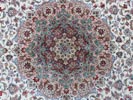
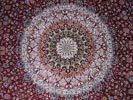
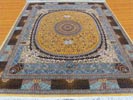
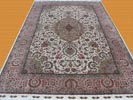
Persian design silk rugs made in China.
The art of Persian carpets also influenced Chinese carpets.
But Persian design carpets didn’t become popular in China
until 1980s. Due to the Iran-Iraq War and embargo from Iran,
large quantities of copies of Persian rugs were made in China
and other Asian countries to meet the demands of the international
market. Chinese Persian design rugs became more popular and
Persian rugs from Iran declined in sales and in quality. Chinese
craftsmen exerted their wisdom to make much higher quality
Persian design rugs. They used finest silk yarn to make a
large number of knots per square foot on the carpet. The superb
quality and lower price of Chinese Persian silk rugs soon
occupied the international market. Most Persian rugs from
Iran were made of wool, some of them made of wool mixed with
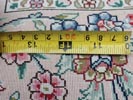
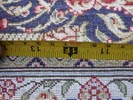
silk. Most of the rugs have less than 200 lines per foot.
While Chinese Persian designs silk rugs have 260,300 lines
per foot. Some small refined silk tapestries even have 400,500,600,
700, 800 or 1000 lines per foot. More lines means more knots,
more work and more intricate designs. A lot of carpet dealers
imported our Persian designs silk rugs but tagged with Iranian
labels or Turkish labels to sell and made huge profits. However,
it is a pity that most buyers didn’t know the origin of those
carpets was from China.
|
|
Double
Click Small Picture to See Its High Definition Image. |
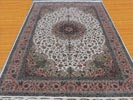
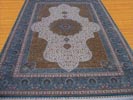
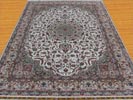
z185283,185x283cm
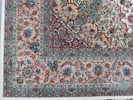
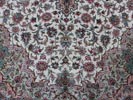
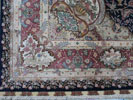
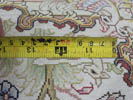
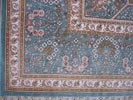
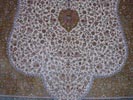
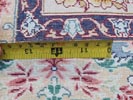
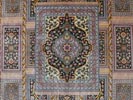
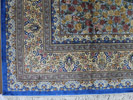
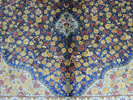
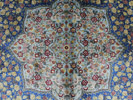
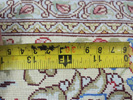
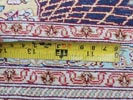
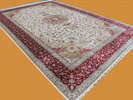
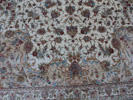
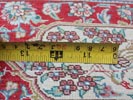
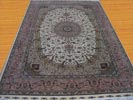
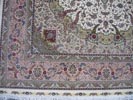
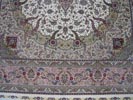
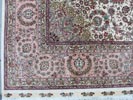
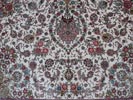
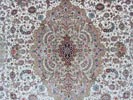
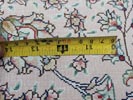
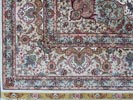
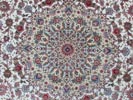
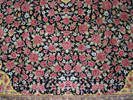
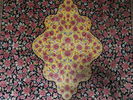
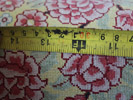
Persian design silk carpet,100% genuine mulberry silk piles
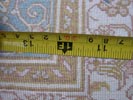
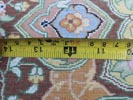
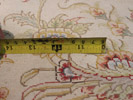
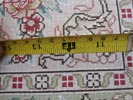
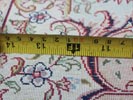
on silk warps, standard 260lines, 22lines per inch, 470 real
tied double knots per square inch quality,wheat color border
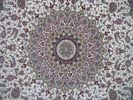
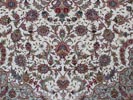
with white field, pile height around 5mm, weighs around 14kg.Qum
design silk rug, central medallion with inner brackets layout,
floral pattern, 2 girls around 12 months to make,257x354cm size
is in stock .
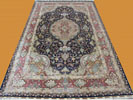
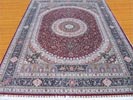
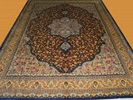
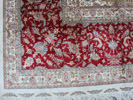
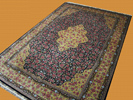
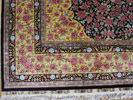
z188278,
185x280cm hand-knotted silk carpet,100% genuine
mulberry silk piles on silk warps, standard 260lines, 22lines
per inch, 470 real tied double knots per square inch quality,piles
height around 5mm, weighs around
14kg.Qum design silk rug,
central medallion with inner brackets
layout, floral pattern, red border with dark blue field,
washable, 2 girls around 12 months to make.
z201307,
201x307cm area silk rug,100% genuine
mulberry silk piles on silk warps, standard 260lines, 22lines
per inch, 470 real tied double knots per square inch quality,light
blue border with white and golden field, pile height around
5mm, weighs around16.5kg.Qum design silk rug, central medallion
with inner brackets layout, floral pattern, washable, 2 girls
around 15 months to make,8x10ft size is in stock.
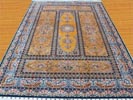
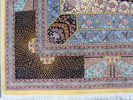
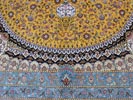
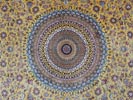
z206307,
206x307cm golden silk rug,100% genuine mulberry
silk piles on silk warps, standard 260lines, 22lines per inch,
470 real tied double knots per square inch quality,blue border
with golden field, pile height around 5mm, weighs around 16.5kg.Qum
silk rug, washable, geometric design, 2 girls around 15 months
to make.
z205306,
205x306cm Persian design silk rug,100%
genuine mulberry silk piles on silk warps, standard
260lines, 22lines per inch, 470 real tied double knots
per square inch quality, blue border with red field,
pile height around 5mm, weighs around 16.5kg.Qum silk
rug, central medallion with inner brackets layout,
floral pattern, washable, 2 girls around 15 months
to make.
|
z248312,
248x312cm
geometrical layout silk carpet,100% genuine mulberry
silk piles on silk warps, standard 260lines, 22lines
per inch, 470 real tied double knots per square inch
quality, brown border with multi colors field, pile
height around 5mm, weighs around 22kg.Qum design silk
rug, geometrical design,washable, 2 girls around 19
months to make.
|
z245307,
252x311cm blue silk rug,100% genuine
mulberry silk piles on silk warps, standard 260lines,
22lines per inch, 470 real tied double knots per square
inch quality, golden border with blue field, pile height
around 5mm, weighs around 22kg. central medallion with
inner brackets layout, floral pattern, Tabriz design,
washable, 2 girls around 19 months to make.
|
| z252319,
252x319cm Persian silk rug,100% genuine
mulberry silk piles on silk warps, standard 260lines,
22lines per inch, 470 real tied double knots per square
inch quality, brown border with golden field, pile height
around 5mm, weighs around 23kg. washable, central medallionwith
inner brackets layout, floral pattern, Isfahan design,
2 girls around 20 months to make. |
z258356,
378x558cm super large size Persian silk carpet,100% genuine
mulberry silk piles on silk warps, standard 260lines, 22lines
per inch, 470 real tied double knots per square inch quality,
red border with white field, pile height around 5mm, weighs
around 54kg, central medallion with inner brackets layout,
floral pattern, Tabriz design, washable, 4 girls over 2 years
to make.
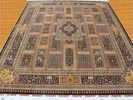
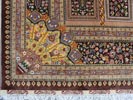
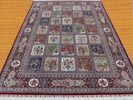
z187276,
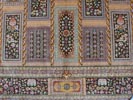
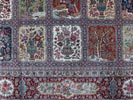
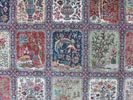
248x312cm garden design silk
carpet,100% genuine mulberry silk piles on silk warps, standard
260lines, 22lines per inch, 470 real tied double knots per
square inch quality,red border with multi colors field, pile
height around 5mm, weighs around 14kg.Qum design silk rug,
geometric garden layout, 2 girls around 12 months to make.
z187285,
248x312cm Nain silk carpet,100% genuine
mulberry silk piles on silk warps, standard 260lines, 22lines
per inch, 470 real tied double knots per square inch quality,brown
broder with white field, pile height around 5mm, weighs around
14kg.Nain design silk rug, central medallion with inner brackets
layout, floral pattern, 2 girls around 12 months to make.
zz203306,
203x306cm 260lines persian silk rug,100% genuine
mulberry silk piles on silk warps, standard 260lines, 22lines
per inch, 470 real tied double knots per square inch quality,brown
border with white field, pile height around 5mm, weighs around
16.5kg.Qum design silk rug, central
medallion with inner brackets layout, floral pattern, washable,
2girls around 15 months to make.
z186277,
186x277cm bed room use silk rug,100% genuine
mulberry silk piles on silk warps, standard 260lines, 22lines
per inch, 470 real tied double knots per square inch quality,
wheat color border and white field, piles height around 5mm,
weighs around 14kg.Qum design silk rug, central medallion
with inner brackets layout, floral pattern, washable, 2 girls
around 12 months to make.
zz186280,
189x287cm rose design silk carpet,100%
genuine mulberry silk piles, standard 260lines, 22lines per
inch, 470 real tied double knots per square inch quality,
pile height around 5mm, weighs around 14kg.Qum design silk
rug, washable, rose flower design, 2 girls around 13 months
to make.
Next
Page :2
-- 3
-- 4
-- 5
-- 6
-- 7--
8 |
Phone:(+86)-13501103837
Wechat:13501103837 Fax:(+8610)-65854230 E-mail: chinasilkug@msn.com
Beijing silk rug stroe address:Building 31-1707, Zaoyingbeili,
Chaoyang District, Beijing,China
|